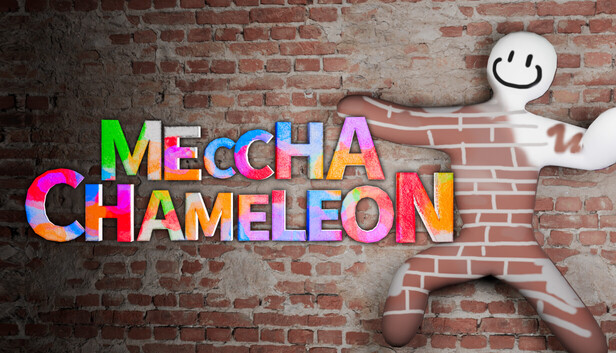
The complete guide to painting, camouflage designs, and decoys in MECCHA CHAMELEON. Get paint ideas, master the eyedropper & opacity tools, and outsmart the Hunter every round.
MECCHA CHAMELEON is a multiplayer paint-and-hide party game — think "graffiti hide-and-seek" or an artist's take on Prop Hunt. During a timed prep phase, Hiders paint their white chameleon body to match walls, floors, and props. Seekers must find and tag everyone before the timer hits zero.
HIDER
Paint. Hide. Survive.
Start as a white chameleon body
Paint yourself to match the environment
Choose a hiding spot and strike a pose
Stay still until the timer ends
SEEKER (HUNTER)
Find. Tag. Win.
Wait while Hiders prepare
Scan the area for anomalies
Look for color mismatches and shape breaks
Tag Hiders before time runs out
The Three Pillars of Success
Painting
Match colors and patterns from nearby surfaces using the Meccha Paint system
Position
Choose hiding spots where your camouflage has natural advantages
Pose
Strike poses that mimic nearby objects and blend your silhouette
PAINT DESIGNS
MECCHA CHAMELEON Paint Designs & Camouflage Ideas
Stuck on what to paint? These MECCHA CHAMELEON paint ideas and camouflage designs cover every common surface — from brick walls and tiled floors to props, foliage, and graffiti. Pick the design that matches your map, then fine-tune with the paint tools below.
🧱
Brick & Wall Camouflage
Paint a repeating brick or panel grid, then break the seams with grime and shadow. The best wall design copies the mortar lines exactly so your silhouette disappears into the pattern.
🟦
Tile & Mosaic Designs
Mosaic and checker floors are forgiving because the busy pattern hides small errors. Align your grid to the real tiles and keep the grout lines consistent across your body.
🎨
Graffiti & Banner Blends
On graffiti walls and banners, go bold. Loud spray-paint shapes actually help here — the chaos of the design overwhelms the Hunter's eye and buries your outline.
🌿
Foliage & Nature Skins
Leaves, bushes, and wood grain are irregular by nature, so imperfect painting looks realistic. Add random darker specks to mimic depth and dappled light.
📦
Prop & Object Mimic
The classic "square body" trick: pose flat against a box, crate, or vent and paint yourself as that object. Match the edges and you read as furniture, not a player.
💡
Lighting & Shading Match
Great designs fail under the wrong light. Paint a subtle gradient — brighter where light hits, darker in shadow — so your skin reacts to the room like a real surface.
Pro tip: the strongest camouflage design isn't the prettiest — it's the one that matches your exact hiding spot's texture, lighting, and shape. Save your favorite paint ideas and reuse them per map.
You don't get found because you "hid badly" — you get found because something looks wrong. Seekers aren't matching your paint to the wall; the human eye is an anomaly detector that instantly flags shape breaks, texture mismatches, and movement. Fix these three conflicts and your detection rate drops fast.
1. Your Silhouette Breaks
A chameleon-shaped outline against a flat wall is a dead giveaway, even with perfect color. The eye reads contour before color.
Fix: Pick spots where your shape blends into props, corners, or clutter — not open flat surfaces.
2. Your Paint Is Too Clean
Real surfaces have noise, grain, and shadow. A flat, "perfect" color patch reads as unnatural — matching one color is not the same as blending in.
Fix: Copy the texture and shading, not just the hue. Add slight variation so it feels natural.
3. You Moved
Motion is the loudest signal of all. The eye catches movement faster than any color error — one nervous adjustment and you're spotted.
Fix: Commit to your spot early and stay completely still until the timer ends.
The Camouflage Priority Order
Most new players do this backwards — they obsess over color first. Fix conflicts in this order for the biggest survival gains:
1st
Position
Choose a spot where your shape already fits
2nd
Silhouette
Break up your outline against the background
3rd
Texture
Match grain, noise & shadow, not just color
4th
Color
Fine-tune the exact hue last
HIDER GUIDE
Become Invisible
Master the art of camouflage with these proven hiding strategies.
01
Match Before You Move
Sample colors from your intended hiding spot BEFORE committing. Use the eyedropper tool to pick exact shades.
Priority: HIGH
02
Silhouette First, Color Second
A wrong shape will get you caught instantly. Match your contour to nearby objects before worrying about exact colors.
Priority: CRITICAL
03
Stay Absolutely Still
Motion is the #1 giveaway. Once hidden, do NOT adjust your position. Movement triggers instant detection.
Most Common Mistake
04
Go for "Boring" Spots
High-traffic areas look tempting but backfire. Pick low-attention zones where Seekers rarely look.
Pro Tip
05
Break Your Body Into Zones
Torso matches wall, limbs match floor trim, head matches ceiling. Paint in sections for best coverage.
Advanced Technique
06
Embrace Imperfection
Perfect color matches look suspicious. Real surfaces have noise. Add slight variations to feel "natural."
Key Insight
HUNTER / SEEKER GUIDE
Hunter Guide: Spot Every Hider
Train your eye to find what others miss. Here's how the Hunter (Seeker) tracks down every hidden chameleon.
Scanning Patterns
1
Scan High to Low
Start from ceiling level and work down. Players often forget to match overhead elements.
2
Look for Silhouette Breaks
Even with perfect colors, wrong shapes stand out against backgrounds.
3
Check Corners First
Corners and edges are natural hiding spots. Start there before open areas.
Red Flags to Watch
"Too Perfect" Matches
Real surfaces have noise. Perfect colors are often fake.
Shadows Point Wrong
Check lighting direction. Hiders often forget to match shadows.
Slight Movement
Even tiny adjustments are visible. Watch for any shifting.
Painting is your primary weapon. Master the eyedropper, opacity, and layering tools to turn any camouflage design into flawless invisibility.
Essential Techniques
1
Eyedropper Sampling
Use the eyedropper (spoid) tool to pick exact colors from surfaces. Sample multiple points and blend for best results.
2
Gradient Blending
Don't just pick one color. Real surfaces have subtle gradients. Layer colors for depth.
3
Lighting Consistency
Sample colors in the lighting where you'll hide. Colors look different in shadow vs direct light.
4
Pattern Replication
For patterned surfaces (checkers, tiles), practice the pattern layout before hiding time ends.
5
Opacity & Transparency Control
Lower opacity to layer soft, semi-transparent tones over each other. Building color gradually looks far more natural than one solid, fully opaque coat.
6
Auto-Paint & Quick Fill
Use auto-paint / quick-fill to base-coat large areas fast, then hand-detail the edges. Never rely on auto camo alone — the seams and silhouette still need a manual pass.
Common Painting Mistakes
Only Matching One Color
Walls have shadows, floors have highlights. Sample the full range, not just one spot.
Rushing the Paint Job
You have preparation time. Use it. A quick sloppy paint is worse than no paint at all.
Forgetting the Back
Seeker can approach from any angle. Paint your entire visible body, not just front.
Copying Nearby Colors Blindly
Match colors from your hiding SPOT, not where you're standing. Distance matters.
MIND GAMES
MECCHA CHAMELEON Decoys & Misdirection
Camouflage hides your body — decoys hide your intent. The best players don't just blend in, they bait the Hunter's attention somewhere else. Here's how to use decoys and misdirection to survive.
🫥
Decoy Tactics for Hiders
›Paint an obvious "trap" spot. Leave a tempting but empty-looking area that draws the Hunter's eye away from your real position.
›Blend beside a real prop. Copy a nearby object so the Hunter assumes you're just another decoy piece of scenery and moves on.
›Break line-of-sight patterns. Hide where the Hunter's scan naturally "skips" — behind a focal point they've already cleared.
›Never cluster. If one Hider is found, nearby Hiders get checked next. Spread out so a catch doesn't expose you.
🎯
Beating Decoys as the Hunter
›Don't chase the obvious. An "easy" target is often a decoy set up to burn your clock. Confirm quickly, then move on.
›Test with movement. Real Hiders flinch or hold unnaturally still. Approach suspicious "props" from a new angle to break their illusion.
›Re-scan cleared zones. Smart Hiders sit where you already looked. Sweep the same area twice from different heights.
›Watch the edges. Decoy paint jobs often nail the color but miss the shadow line where the object meets the floor.
Quick answers to the questions players ask most about camouflage, painting, and getting caught.
What is MECCHA CHAMELEON?
MECCHA CHAMELEON is a multiplayer paint-and-hide party game on Steam. You play a white chameleon and use an in-game color palette to paint your whole body to match the environment, then hide from Seekers who must find everyone before the timer runs out. It's often described as "graffiti hide-and-seek" or an artist's twist on Prop Hunt. It released in 2026 and became the #1 global top seller on Steam.
Why do I always get caught in MECCHA CHAMELEON?
Usually it's one of three things: your silhouette breaks against the background, your paint is "too clean" and lacks natural texture, or you moved. Seekers spot anomalies, not colors — so fix your shape and position first, match texture second, and stay perfectly still once you've hidden.
How does the Seeker find hiders?
Good Seekers scan for what looks "off" rather than checking every object. They sweep from ceiling to floor, look for silhouette breaks and color mismatches, check corners and edges first, and watch for any movement. The human eye is an anomaly detector — anything too perfect, wrongly shaded, or slightly shifting stands out instantly.
Is matching the color enough to hide?
No. Color is the last priority, not the first. A perfect color match with the wrong shape, no texture, or bad shadow direction still gets spotted. Match your position and silhouette first, replicate the surface texture and shading second, then fine-tune the exact hue.
What are the best hiding spots?
The best spots are "boring," low-attention zones where your chameleon shape already blends with nearby props, clutter, corners, or repeated patterns. Avoid open flat walls and high-traffic focal points — even great paint can't save a bad silhouette in an obvious location.
What are the best paint designs and camouflage ideas?
The best MECCHA CHAMELEON paint design is the one that matches your exact hiding spot. Reliable go-to ideas are brick/wall grids, tile and mosaic floors, graffiti and banner blends, foliage/nature skins, and prop mimics (the "square body" box trick). Copy the surface texture and lighting, not just the color, and add small imperfections so it looks natural.
What are decoys in MECCHA CHAMELEON?
Decoys are misdirection tactics: you make one spot look like the "obvious" hiding place to pull the Hunter's attention away from where you actually are, or you blend beside real props so the Hunter dismisses you as scenery. As the Hunter, don't chase easy targets, re-scan cleared zones, and check the shadow line where objects meet the floor to catch decoy paint jobs.
How do I use the eyedropper tool and opacity settings?
Use the eyedropper (spoid) tool to sample the exact color from the surface you want to copy — take samples from several points and blend them. Then lower the opacity to layer semi-transparent coats for a natural gradient instead of one flat, fully opaque color. Auto-paint is great for base-coating fast, but always hand-detail the edges and shadows afterward.
How much does MECCHA CHAMELEON cost and where can I play it?
MECCHA CHAMELEON is available on Steam for PC at $5.99. It's a multiplayer game, so it's best played online with friends or in matchmaking. You can grab it from the official Steam store page.
Ready to Master Camouflage?
Download MECCHA CHAMELEON on Steam and start your journey to becoming invisible.